
One thing I specifically wanted out of graduate school in Learning Design and Technology was experience with Articulate Storyline. It was a skill I hoped to leave the program with and bring into the workplace. When we moved away from Storyline in LDT 504, I was disappointed. That was an opportunity I had been looking forward to.
The pivot became both the hardest part and one of the most valuable parts of this course. I learned to use AI to help create a working HTML learning experience, something I would not have known how to build when we started. I’m proud of that, and I still wish I had gained the Storyline experience I came for. Both things are true.
It left me wondering how the skills expected of learning designers might change as AI becomes more common. I still want to learn Storyline. I also have a better understanding of what I can create when the tool I expected to use is no longer part of the plan.
Figuring Out What Was Essential
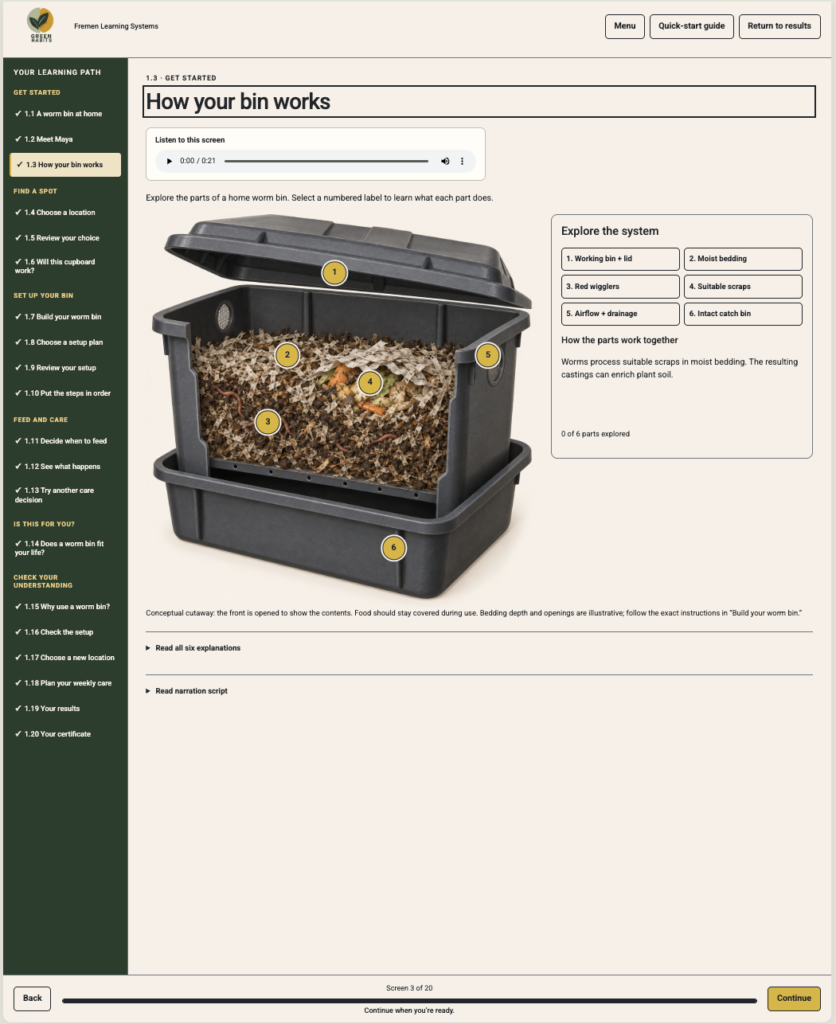
My project focused on small-space vermiculture. Learners explored whether a worm bin could fit their home and routine, made decisions about setup and care, and received feedback about those decisions. Moving from the design case, learner persona, and storyboard to a functioning module meant figuring out how those plans would actually work for someone.
One challenge came when we redesigned the experience for a low-bandwidth environment. I had invested time in the original module, and I wanted the simpler version to feel complete. At the same time, I did not want to keep things just because they were already there.
I remember questioning whether I had included more than the learner actually needed. I wanted to make sure I was preserving what was essential instead of just making a smaller version of the same thing.
Learners still needed to choose a location, consider setup conditions, make feeding decisions, and understand the consequences. Those interactions and the feedback were essential. Repeated explanations and extra presentation elements could be simplified.
Working with AI, I trimmed repeated text while keeping the decisions, feedback, and assessment. That helped me see that removing something can be as much a design decision as adding it.
Looking Finished Was Not Enough
Another moment that stayed with me was opening an early version of the offline module and finding no working way to start. It looked like a learning experience, but the learner could not begin.
That was a reminder that generating a file was only one part of the process. I had to work through it and notice what happened.
As the module developed, there were more things to check. Did each recording play on the correct page? Did the learner receive feedback after making a decision? Could they move through the activities and reach the assessment? Did the content still reflect what I intended?
I tested the low-bandwidth version on my computer and iPhone, and it worked smoothly after revisions. That mattered because I wanted the experience to work beyond the screen where it was created.
If I started again, I would test smaller sections as I built them and keep a list of what I had checked. I would also leave more time for testing the complete experience. It is easy to underestimate that part when so much attention goes into getting everything built.
Where AI Helped and Where I Had to Decide
AI made the technical side of this project possible for me. I used ChatGPT as a development partner, describing interactions, requesting revisions, and troubleshooting when something wasn’t working. I didn’t know how to write the HTML code myself, but I could communicate what I wanted the learning experience to do and evaluate whether the results matched my intentions. It helped me move from the plans in my storyboard to pages I could actually use and test.
I also loved seeing how classmates working from the same starting prompt created different layouts, language, graphics, and processes. Seeing their work made me think again about my own choices.
There were still moments when I had to catch something that no longer belonged. An introduction video placeholder remained after I had chosen to use introduction audio. It needed to be removed because it no longer reflected the experience I was creating.
The low-bandwidth revision required even more judgment. AI could shorten text, but I had to consider whether the shorter version still supported the learner. I became more specific about what I wanted changed and what needed to remain.
One decision I wanted to preserve was allowing learners to decide that a worm bin did not fit their lives. “Yes,” “not yet,” and “no” were all valid personal outcomes. Someone could understand the setup and care requirements and still decide against starting a bin.
The assessment measured understanding. The personal reflection helped learners consider their circumstances. Keeping those separate mattered because I wanted the module to support an informed decision. Choosing not to start a bin did not mean the learner had failed.
What This Means for My Next Project
I’m still disappointed that I did not get the Storyline practice I expected. I also recognize that this course gave me experience with a different approach that may become increasingly useful.
I wonder whether knowing one particular authoring tool will carry the same weight as AI-assisted development becomes more common. I cannot answer that yet. What I can say is that I now see more possibilities for building a learning experience, including a simpler version for someone using a phone or working with limited connectivity.
That flexibility brings responsibility. Being able to create something quickly means I need to be careful about deciding what belongs, what works, and what helps the learner.
The practice I want to carry forward is testing from the learner’s point of view before calling something finished. I want to ask whether someone can navigate it, understand the feedback, and use what they learned to make a decision.
I’m proud of my small-space vermiculture module. The process took patience, and there were moments when I needed help figuring out the next step. It also showed me that I can learn an unfamiliar process and create something technical. I’m leaving with a clearer understanding of the skills I still want to develop and new capabilities I never expected to gain.