
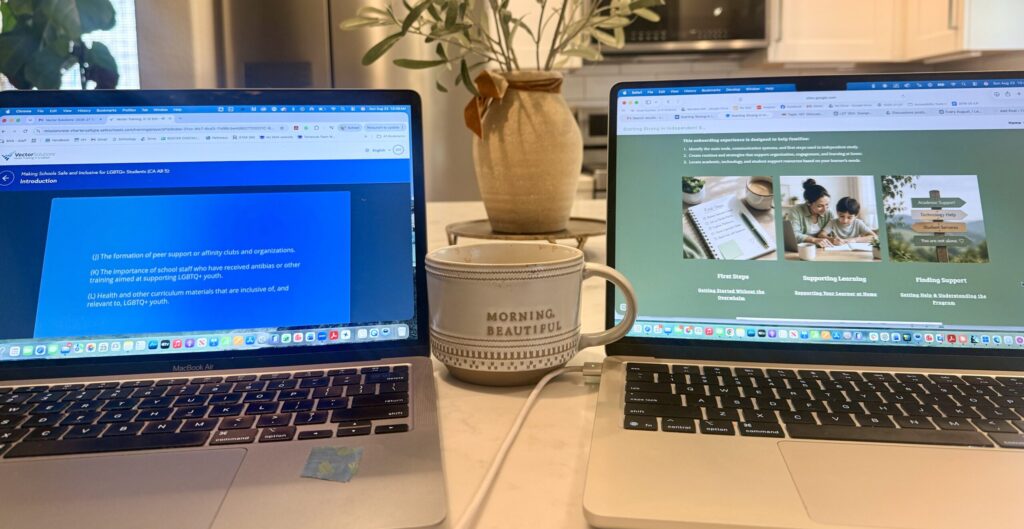
Every August, before my students log in for the first day of school, I have my own back-to-school ritual. It doesn’t involve decorating my office, organizing my workspace, or planning engaging lessons. Instead, I settle in with my laptop, a second monitor, and an ever-growing list of mandatory online trainings. Sexual harassment prevention. Mandated reporter. Bloodborne pathogens. Workplace violence. Heat illness prevention. Student privacy. CPR. AI policy acknowledgments. Forty or so hours later, I’ve clicked through dozens of videos, answered hundreds of quiz questions, and officially checked every required box. The irony is that by the end, I’m not thinking about any of the content. I’m simply relieved to be finished.
Over the years, I’ve developed the same routine that many educators quietly admit to. The videos play on one screen, usually muted, while I prepare lesson plans, answer emails, or organize materials for the school year. Every few minutes I click “Next.” When the quiz appears, I take it. If I miss a question, I take it again. I don’t do this because I think the topics are unimportant. Quite the opposite. Every one of those topics matters. I do it because somewhere along the way, the learning experience became less about learning and more about compliance.
A year ago, I probably would have stopped there and simply complained that the training was boring. But somewhere between beginning my master’s program in Learning Design and Technologies and completing another round of required modules this August, I realized I was asking a different question. Instead of wondering why I disliked the experience, I found myself wondering why it had been designed in a way that encouraged experienced educators like me to disengage.
That realization stayed with me because, at the very same time, I was thinking about my favorite course in the program: LDT 508, Accessible and Inclusive Online Learning. Experiencing these two very different approaches to digital learning during the same month completely changed how I think about learning design.
The problem with our annual compliance training isn’t the content. I genuinely believe every one of those topics matters. The problem is how we’re asked to learn them. Every module follows the same pattern: watch a video, answer a simple question, and finish with a quiz that can be retaken until it’s passed. Whether you’re a new teacher or someone who’s completed these trainings for years, everyone follows the exact same path.
Through Merrill’s First Principles of Instruction, I can explain why the experience falls flat. I spend hours consuming information, but I’m rarely asked to apply it in authentic situations or exercise the professional judgment I would actually need if one of those situations occurred at school. Instead, success is measured by completion. The design unintentionally encourages experienced educators to get through the modules as efficiently as possible rather than engage deeply with the material. Somewhere along the way, learning quietly became checking boxes.
LDT 508 couldn’t have felt more different.
On the surface, it looked like every other graduate course. A few weeks into the semester, though, I realized every assignment was intentionally moving me toward one meaningful project. Rather than completing disconnected assignments that disappeared after grading, I spent the term creating an onboarding website for new families entering our independent study program.
That single design decision changed everything for me.
I wasn’t working toward a grade.
I was working toward a solution.
As an educator, I’ve watched countless new families enter independent study feeling overwhelmed by the amount of information they’re expected to absorb during those first few weeks. I wanted to create something that slowed the experience down and helped them take one step at a time. Every assignment moved the website forward, and every round of instructor feedback made it stronger. The feedback wasn’t simply about earning points. It helped me make better design decisions for something I knew real families would eventually use.
Looking back, I can clearly see why the course stayed with me. Every week I worked on a problem that genuinely mattered to me through a creative process that played to my strengths. I had the freedom to make my own design decisions, try new ideas, and watch the project evolve into something I knew I would actually use. Along the way, I applied new ideas immediately, refined my work through feedback, and integrated what I was learning into my everyday practice. The learning never felt separate from my work because it wasn’t. It became part of my work and, ultimately, part of the experience I wanted to create for new families.
In many graduate courses, discussions ask us to thoughtfully incorporate course readings into responses to design questions. Sometimes those conversations are valuable, and sometimes they simply become another assignment before moving on to the next week. LDT 508 approached discussions differently. Rather than only reading about accessibility and inclusion, we experienced simulations that allowed us to briefly step into the perspective of learners with different disabilities. The readings suddenly had context because they helped explain something I had just experienced myself. I wasn’t only learning about accessibility. I was beginning to understand why thoughtful instructional message design matters from the learner’s perspective.
The greatest validation came months later.
I launched the website before the new school year, hoping it would make the onboarding process a little less overwhelming for new families.
And you know what? It worked.
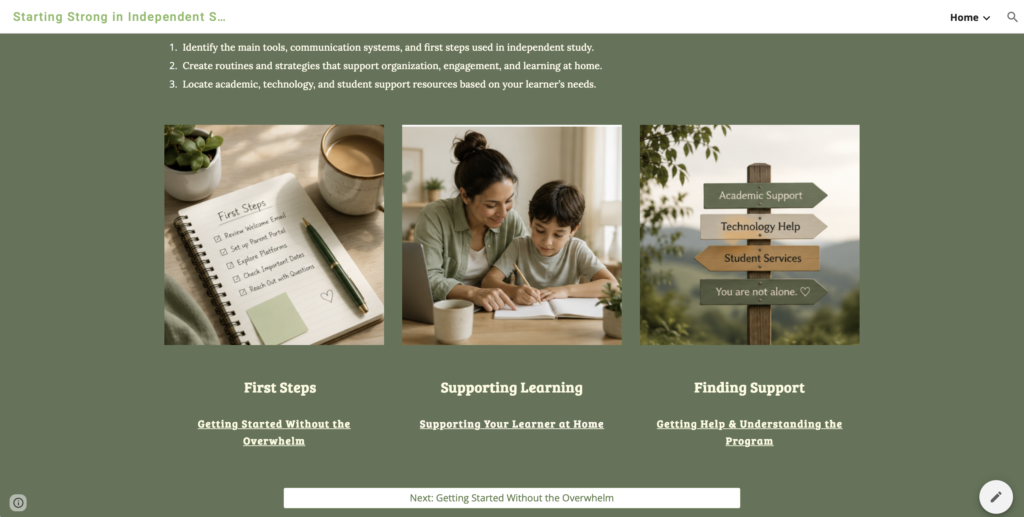
Several parents told me the website helped them know where to begin and made the transition into independent study feel much less overwhelming. That feedback meant far more than any grade because it confirmed the project was accomplishing exactly what it was designed to do. The course didn’t end with my final assignment. It continued every time a new family used that resource.
Looking back, these two learning experiences taught me the same lesson from opposite directions. One showed me how easily learners disengage when the goal becomes completing training. The other showed me what happens when learning is built around solving meaningful problems that extend beyond the classroom. As I continue growing as a learning designer, that’s the principle I want to carry into every project I create. I want learners to leave with more than a completed checklist. I want them to leave with something they can immediately use to make their work, or someone else’s experience, just a little bit better. To me, that’s the kind of learning worth remembering.