
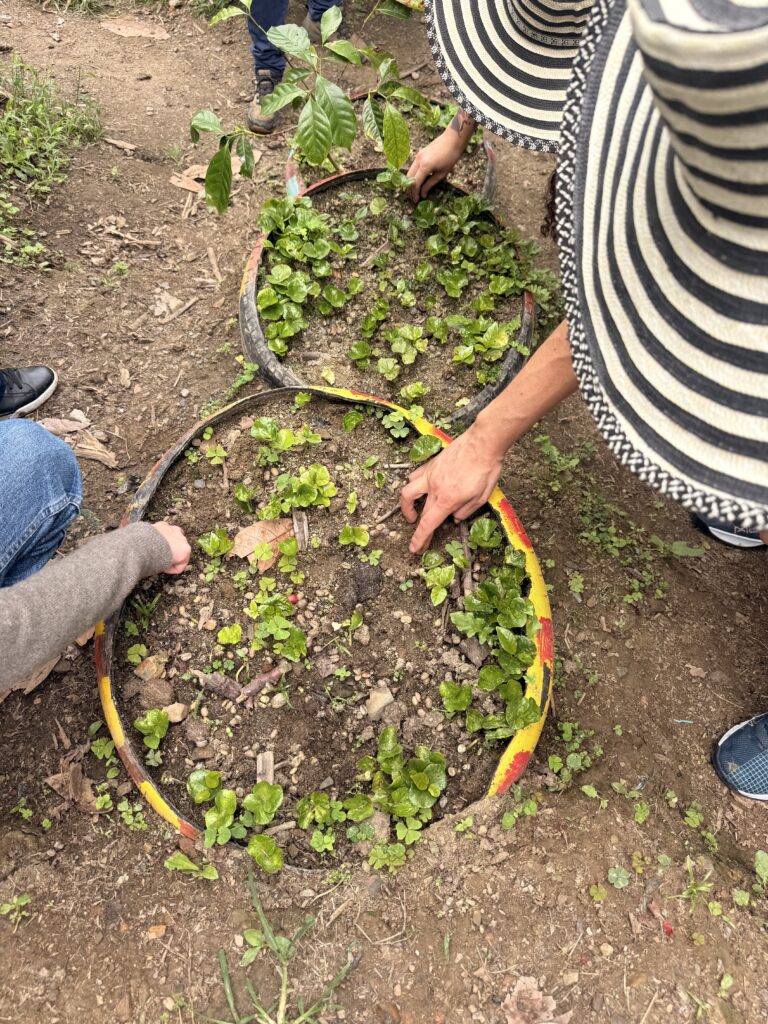
Going into this second self-assessment, I felt a lot more familiar with the evaluation process, but I still wasn’t totally sure how to rate myself. As I worked through the self-assessment, I kept in mind the evaluator competencies outlined by the American Evaluation Association and the broader frameworks discussed in Stevahn et al. (2005), which helped me better understand what effective evaluation practice actually looks like.
Looking back, this process actually reminds me of the image I included above. It’s not about everything being fully developed right away. It’s more about paying attention to what’s there, working with others, and gradually improving things over time.
My role in the project was mostly writing the executive summary and helping keep things organized, so part of me kept thinking, “I didn’t actually design the evaluation, so how much did I really do?” But once I worked through each competency, I realized I was giving myself too little credit in some areas and also seeing more clearly where I still need to grow.
Where I Am Now
Right now, I would place myself at about a 4 out of 6 as an evaluator. I feel confident contributing, especially when it comes to communication, making sense of information, and working with a team. At the same time, I know I’m not at the point where I could independently design or run a full evaluation, so I don’t want to overstate that.
What Changed
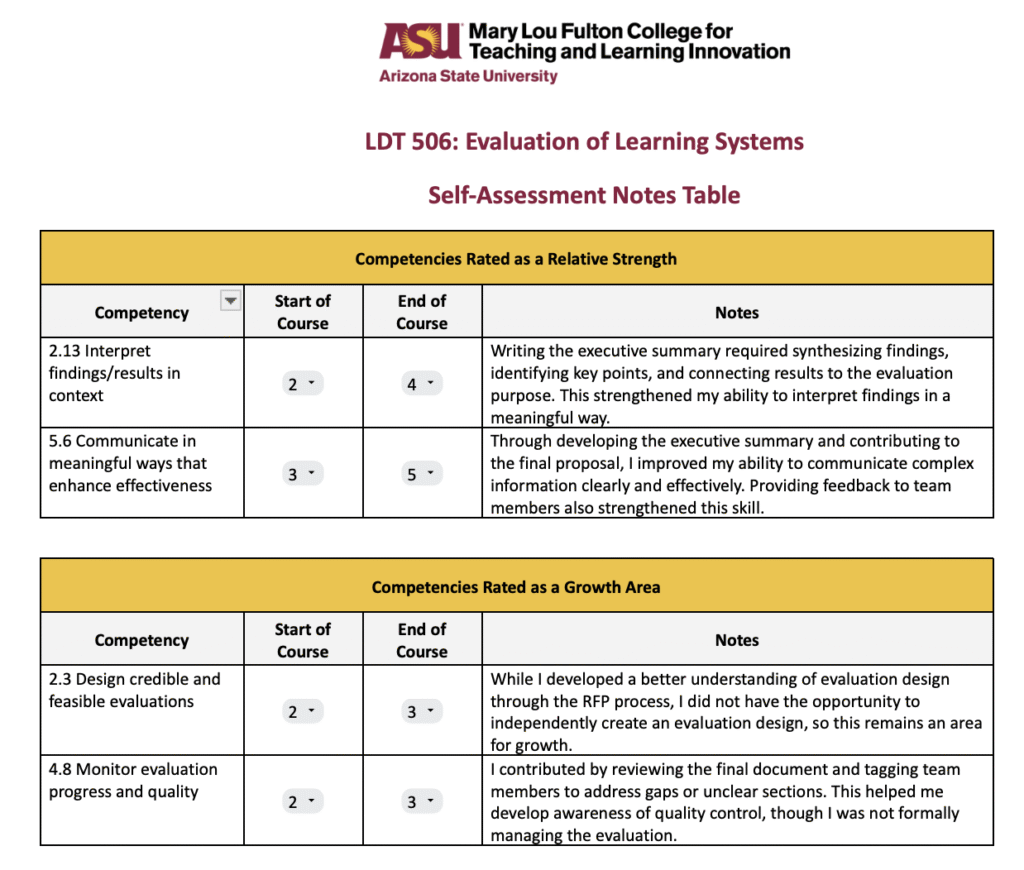
One of the biggest areas where I saw a change was in 2.13 (interpreting findings in context) and 2.14 (using evidence to draw conclusions and make judgments). At the beginning of the course, I rated myself lower here because I hadn’t really worked with evaluation findings before. That changed a lot when I wrote the executive summary for our RFP. It sounds simple, but it actually wasn’t. I had to go through everything and decide what actually mattered, what could be cut, and how it all connected back to the purpose of the evaluation. It wasn’t just summarizing, it was making decisions about meaning. That’s where I realized I was actually interpreting information, not just repeating it. Because of that, I felt comfortable moving my rating up in both of those areas.
Another area that changed for me was 4.8 (monitoring evaluation progress and quality). At first, I rated myself low because I wasn’t managing anything officially. But toward the end of the project, I was going through the final document and tagging people where things were unclear or missing. I wasn’t in charge, but I was still paying attention to the quality of the work and pushing it to be better. That made me rethink what “monitoring quality” actually looks like. It’s not always about being the project manager. Sometimes it’s just being the person who notices things and says something.
Strengths & Growth Areas
I also saw growth in 5.8 (managing conflict constructively) and 5.7 (facilitating constructive interaction), even though I didn’t think I would at first. Early on, I pushed back on using WhatsApp instead of Slack. It wasn’t a big conflict, but it was still a difference in opinion. We talked it through and ended up sticking with WhatsApp because it was more accessible for everyone. What stood out to me was that I was able to bring it up, hear the reasoning, and move forward without it turning into anything negative. Later, when I was tagging people in the document to fix gaps, I also had to be intentional about how I gave feedback so it didn’t come off the wrong way. Those moments made me realize that constructive interaction is not just about avoiding conflict. It’s about how you show up in those situations.
Looking at everything overall, my strengths are pretty clear. I’m strongest in communication, organization, and making information understandable. The executive summary really highlighted that for me. I’m comfortable taking something complex and turning it into something clear and usable. I also think I’m a solid team member. I’m willing to speak up, ask questions, and help improve the final product, even if I’m not leading the project.
On the other hand, my growth areas are also pretty obvious. I need more experience with actually designing evaluations, choosing methods, and working with data. I understand those things conceptually, but I haven’t had to do them myself in a real way yet. I also want more experience working directly with stakeholders, because most of my interaction in this course was just within my group.
What Surprised Me
One thing that honestly surprised me was how important the interpersonal side of evaluation is. I went into this thinking evaluation was mostly about data, methods, and analysis. But a lot of the competencies are about communication, relationships, and understanding different perspectives. Things like managing conflict, building trust, and making sure results are actually useful stood out to me more than I expected. It made me realize that evaluation isn’t just technical. It’s also very people-focused.
What’s Next
Moving forward, there are a few things I would want to focus on to keep improving. First, I want more hands-on experience with evaluation design and methodology, because that’s where I still feel the least confident. Second, I want to build my skills in data collection and analysis, especially since that’s a big part of evaluation work that I haven’t really practiced yet. And finally, I’d like to get more experience working with stakeholders, because that’s where a lot of the communication and interpersonal skills really come into play.
Overall, this self-assessment helped me see that even though my role in the project was not the most technical, I still developed important skills. I contributed in ways that mattered, especially in communication and improving the final product. At the same time, I have a much clearer understanding of what I still need to learn. I feel more confident in where I am now, and more realistic about what comes next.
Self- Assessment Notes Table:
References
- American Evaluation Association. (n.d.). AEA evaluator competencies.
- International Board of Standards for Training, Performance and Instruction (IBSTPI). (n.d.). Evaluator competencies.
- Stevahn, L., King, J. A., Ghere, G., & Minnema, J. (2005). Establishing essential competencies for program evaluators.