
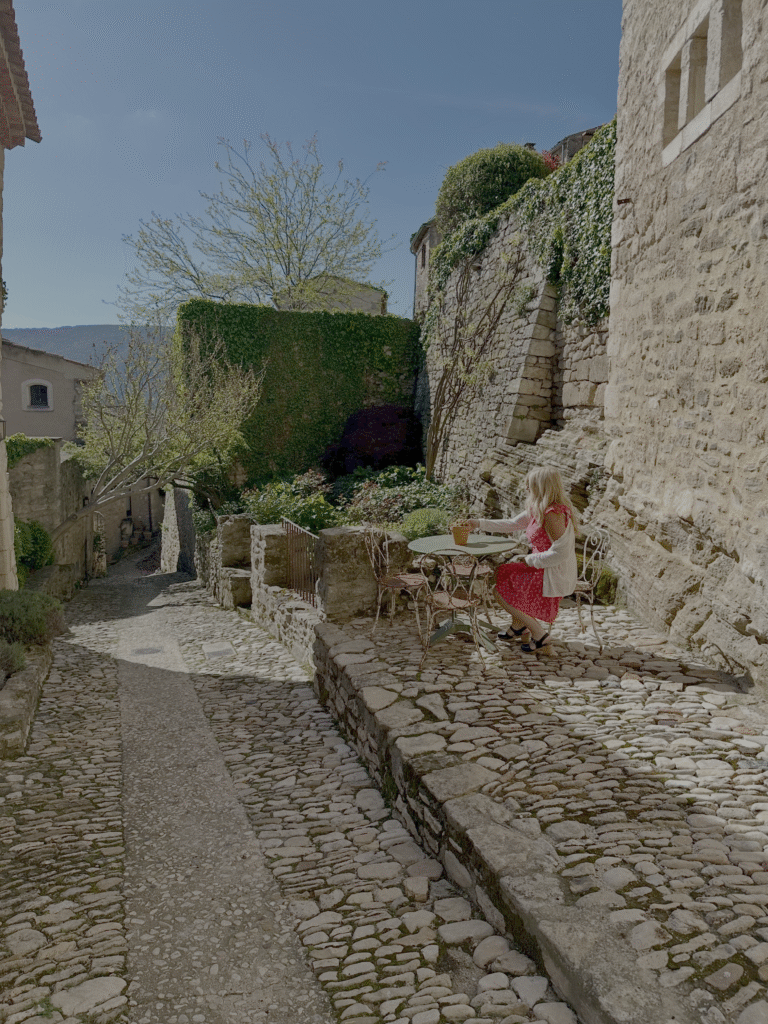
Photo: Captured in Provence, France—a quiet moment that reminded me how learning design, like life itself, is built from both structure and soul. It’s where observation becomes reflection, and reflection becomes creation.
The night I hugged my youngest daughter goodbye in her college dorm, I knew I was entering a new season of my life—one that would require me to learn, stretch, and design in new ways. What I didn’t know then was how deeply this program would already begin to reshape me.
In just a few weeks, I’ve started to see learning design not only as a process or profession, but as a way of seeing the world. The field has come a long way from its early roots in projectors and slideshows, evolving into something more human and interconnected (Reiser, 2001a). Somewhere in that evolution, I’ve found my place: I’m here to learn how to build experiences that not only teach, but touch—the kind that stay with people long after the lesson ends.
Short-Term Goal: Learn to Balance Structure and Soul
By the end of this course, I aim to become more proficient in the formal process of instructional design—models such as ADDIE and SAM—but I also want to retain the creative spark that drew me here in the first place. I’ve spent years leading teachers and designing supports for families, much of it built on intuition, empathy, and lived experience. Now I want to merge that heart with a framework—to see how design can be both structured and soulful.
This goal feels urgent because of what I’ve witnessed in my district this fall. A “transformative” new MTSS support model was rolled out—ambitious in theory, designed to serve 7,700 students. But what looked polished on paper crumbled in practice. The software was glitchy, assessments produced skewed data, and the training didn’t align with what we were being asked to do. Implementation felt chaotic. What we experienced wasn’t just a technical problem—it was a design problem.
It reminded me that bright ideas mean little if they aren’t tested with the people who will actually use them. Had someone applied design best practices—testing usability, clarifying scope, and piloting the process—this could have been a success story instead of a cautionary tale. That’s why my short-term goal isn’t just to learn design models; it’s to learn how to use them thoughtfully, to see where theory meets lived experience.
The kind of mentor who could help me here is both analytical and empathetic—someone who values accuracy but never loses sight of the human story within every learning experience. I’m fortunate to already have that in my Director of School Support, whose leadership models how structure can serve, not stifle, creativity. Through her mentorship, I’m learning how to balance innovation with accountability and apply design principles to real educational challenges.
Medium-Term Goal: Design for Systems That Work in the Real World
By the midpoint of this program, I aim to apply what I’m learning to redesign real systems—especially those supporting teachers and students. After years in education, I’ve seen how often initiatives are well-intentioned but poorly designed. Whether a district-wide program, new technology, or “transformative” process, many fall apart because they’re never tested in the living classroom.
The MTSS rollout showed me the problem isn’t always passion or purpose—it’s process. No one paused to think like a designer. There were no prototypes, no user testing, no iterative adjustments. What was meant to lift students instead burdened teachers. I don’t want to be the person cleaning up the fallout of someone else’s design missteps. I want to be the person who prevents them—someone who helps systems succeed before they fail.
I’ve spent my career at the intersection of ideas and implementation. The distance between what’s envisioned and what’s experienced can be vast, and the bridge between them is thoughtful design. I want to become that connector—someone who translates theory into meaningful, workable solutions that honor both learner and practitioner.
To make progress toward this goal, I plan to ground every project I complete in real-world application—testing ideas with teachers, parents, and students to see what works, what doesn’t, and why. Collaborating with educational technologists will help me develop systems that are not only visionary but usable, ensuring theory translates into sustainable practice.
Long-Term Goal: Lead With Story, Strategy, and Heart
By the end of this program, my goal is to lead learning design work that blends empathy, evidence, and impact—whether in higher education, a nonprofit, or community learning organization. I want to design systems and experiences that not only inform but transform—helping people see themselves differently through what they learn.
I imagine building professional learning that feels as alive as a great story—something that carries both clarity and emotion, that lingers after the last slide or session. My journey as a writer has prepared me for this next season. Storytelling taught me structure, rhythm, empathy, and how to guide someone from confusion to understanding. Those same principles apply in design: every learning experience tells a story, and every learner is the protagonist in their own transformation.
Learning design, as Wagner (2011) explains, is less about rigid systems and more about people who can navigate complexity with curiosity, skill, and grace. That’s the kind of designer I want to become. The systems shaping education are changing fast, and too often, humanity is the first thing lost in the process. I want to be a leader who preserves the heart of learning—someone who uses strategy and storytelling to design experiences that foster curiosity, equity, and belonging.
Progress toward this goal will grow through practice and connection—sharing ideas at conferences, building collaborations across sectors, and mentoring others as I’ve been mentored. Partnering with experienced designers in higher education or nonprofit learning spaces could provide the kind of guidance that helps me bridge story, strategy, and heart in leadership.
When I look back at where I started—hugging my daughter goodbye in her dorm and stepping into my own new beginning—I see the same thread running through it all: love as a design principle. The tools may change—software, frameworks, even job titles—but the goal remains the same: to design learning that helps people become more whole, capable, and connected to the world around them.
Closing Reflection
If there’s one thing I’ve learned already, it’s that becoming a learning designer isn’t about mastering tools—it’s about learning to see differently. Every challenge, from a broken rollout to a well-designed course, reminds me that design is both a science and an act of care. My goals are less about titles or outcomes and more about process: to keep learning, connecting, and creating with empathy at the center. I entered this program to gain new skills, but what I’m discovering is something richer—a new way of seeing how learning itself can be designed to mend, empower, and transform.
References
Reiser, R. A. (2001a). A history of instructional design and technology: Part I: A history of instructional media.Educational Technology Research and Development, 49(1), 53–64.
Wagner, E. D. (2011). Essay: In search of the secret handshakes of ID. The Journal of Applied Instructional Design, 1(1), 33–37.